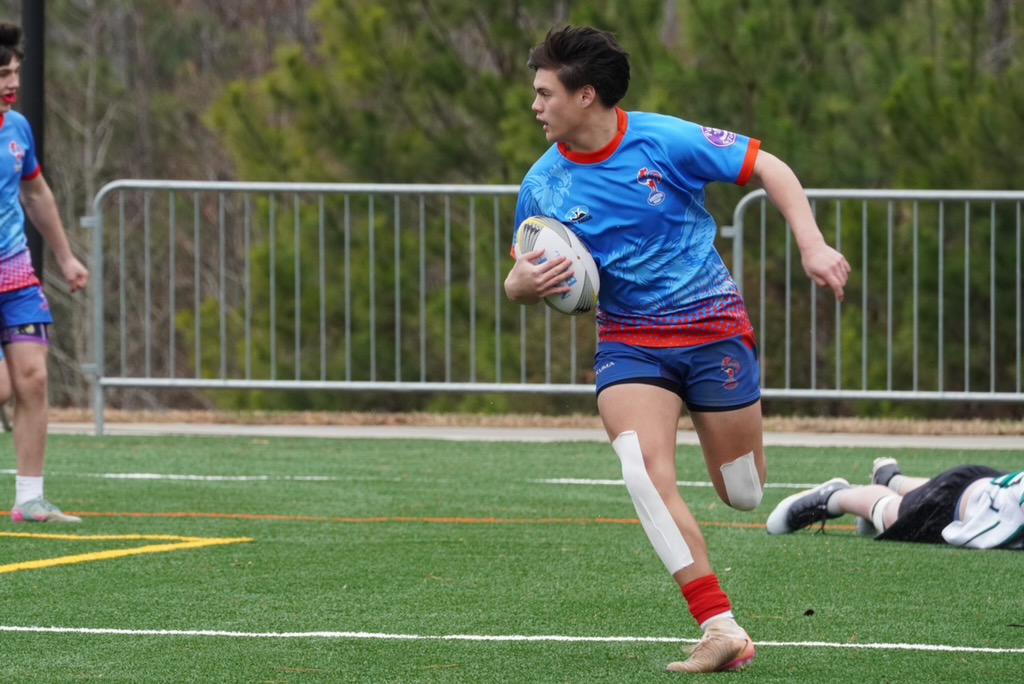
While not yet common enough in America for FCHS to consider adding it as a school sport, rugby has a rich and fascinating history that dates back to 19th-century England. It evolved from informal schoolyard games into a globally celebrated competition. The story of rugby’s birth is famously tied to the Rugby School in the 1800s, when a student named William Webb Ellis picked up the ball during a soccer-style match and ran with it. This tale remains a powerful origin myth and is central to rugby’s identity.
From these humble beginnings, rugby developed into organized forms. The Rugby Football Union was established in 1871, the same year the first international match was played between England and Scotland. Later, Rugby League was established in 1895. From there, the sport spread across continents and became especially popular in countries such as New Zealand, South Africa, England, and Australia.
“I am fortunate enough to be able to travel internationally for rugby, and just seeing the unique styles of play and how different coaching and warm-ups can be is interesting to see,” said FCHS sophomore Jayden Wrigley, who has played travel rugby, including overseas.
The split between rugby union and rugby league occurred in 1895 because of disagreements over player compensation. This was especially important in northern England, where many working-class players wanted to be paid for time missed from work. Rugby union remained amateur for decades, while rugby league embraced professionalism early on. This divide led to differences in rules, gameplay, and culture. Rugby union is often more strategic and contact-heavy, featuring contested scrums, line-outs, and rucks. Rugby league, by comparison, is faster, uses a six-tackle limit before possession is turned over, and does not include contested rucks.
A major shift came in 1995, when rugby union officially became a professional sport. Today, rugby continues to unite players and fans around the world, reflecting both its historical roots and its lasting appeal. It is now played in more than 100 countries. Formats such as Rugby Sevens, a faster-paced version of the game, have also risen in popularity and even earned a place in the Olympic Games.
“The rugby culture is something you don’t see a lot of in other sports. It’s a culture where everyone is family at the end of the day. Whether you’re playing with or against each other, everyone is always close and for the most part friends,” Wrigley said.
Today, when people think of rugby, they often picture big hits and shifty moves, but many know little about the rules. Rugby union, which is what most people picture when they think of rugby, is played between two teams of 15 players. The objective is to score more points by carrying, passing, or kicking the ball and grounding it in the opponent’s in-goal area for a try, which is worth five points. After a try, teams attempt a conversion kick worth two points.
Governed by World Rugby, the game is continuous and highly physical, requiring players to tackle below the sternum and pass the ball backward. After a tackle is made, play continues through contests such as a ruck, where players compete for possession. Set pieces such as scrums and line-outs, restart play after minor infractions, like a dropped ball going forward or the ball going out of bounds.
“Rugby has changed my mentality in various ways, like making me work harder in everything I do, no matter the situation,” said FCHS sophomore Alan Menendez-Flores, who also plays travel rugby. “As for the rules, they were very hard to learn, with not being offsides and not trying to draw penalties,” he said.
While opportunities remain limited in the Fluvanna area, Albemarle High School is starting to build a rugby program, while Culpeper and Richmond both have established teams. Culpeper Youth Rugby and the Richmond Griffins have won numerous state championships and have dedicated multiple athletes to higher-level competition throughout the United States and nationally. Most recently, players from both teams just competed in Florida at the prestigious and highly competitive Tropical 7s tournament, with other players playing internationally in Spain.
Menendez-Flores and Wrigley both currently play with the Maryland Roosters. Since the drive is so far, it is not practical for them to attend practices. Instead, they learn techniques and strategize on their own and then participate in games every Saturday during the spring.
For more information on opportunities with the Maryland Roosters, see the Maryland Roosters’ Facebook page.