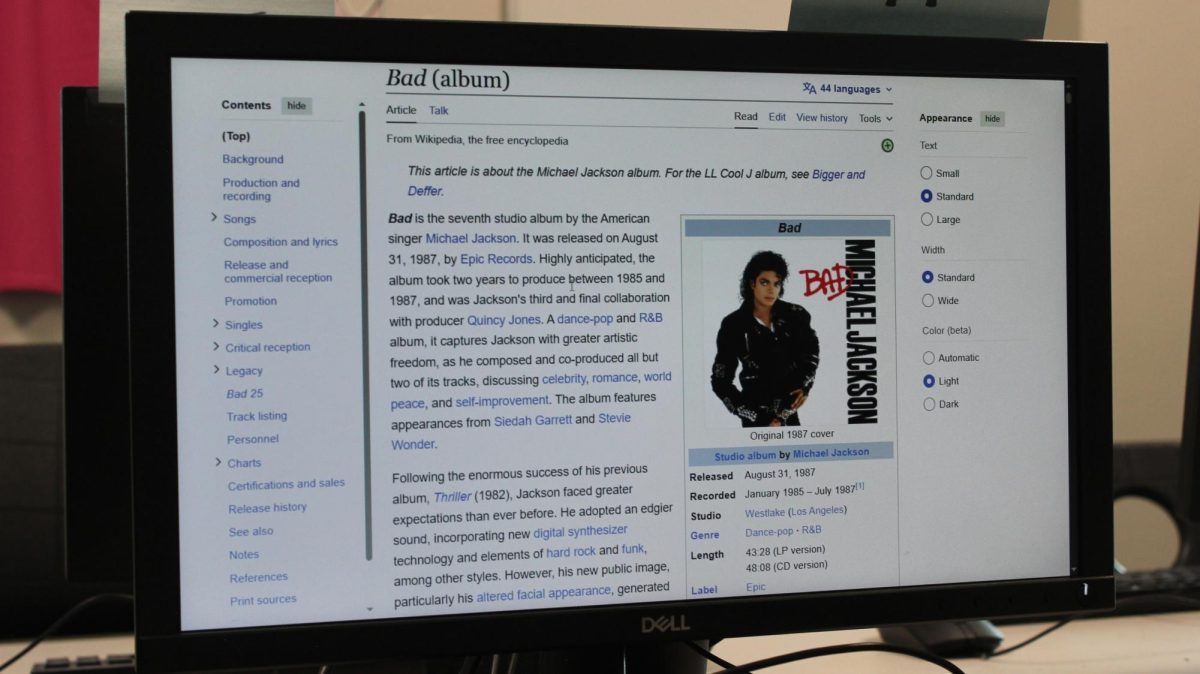
Michael Jackson’s “Bad,” his seventh solo outing, is a landmark album that achieved worldwide commercial success, selling over 35 million copies worldwide. It holds the historic distinction of being the first album to produce five consecutive number-one singles on the Billboard Hot 100 chart, including “Bad” and “Man in the Mirror.” Released on August 31, 1987, the album took two years to produce and was Jackson’s third and final collaboration with producer Quincy Jones.
Before the release of “Bad” and after the release of “Thriller” (which I also recently reviewed), Jackson experienced unprecedented superstardom, winning record-breaking Grammys in 1984. During this period, he joined his brothers for the 1984 Victory tour/album and released the charity single “We Are the World.”
Here is a rundown of the songs on the “Bad” album, and my assessment of why this should be a “must-listen” on your Spotify list.
“Bad”
Although “Bad” was one of Jackson’s most-liked songs, I’m not a fan. As with “Billie Jean” on the “Thriller” album, I think it is overrated and overplayed. I’ve tried to like this song, and I just can’t. I first heard a rendition of this track, which was a parody made by “Weird Al” Yankovic called “Fat,” mocking it. Listening to “Weird Al” Yankovic’s song made me want to find the original song, and when I did, I wasn’t impressed. Compared to his other songs, it just feels unremarkable.
“The Way You Make Me Feel”
From the first beat, “The Way You Make Me Feel” proves why Michael Jackson was one of the greatest entertainers of all time. As his third consecutive number-one single from “Bad” album on the Billboard Hot 100, the song earned its place at the top. It stands out as one of my personal favorites on the album because of its upbeat rhythm and Jackson’s energetic and expressive lyrics. Jackson wrote “The Way You Make Me Feel” (originally titled “Hot Fever”) as a request of his mother, Katherine Jackson, who wanted him to create a “shuffle” old-school R&B song with a 1960s Motown feel. While “Bad” contained streetwise, intense tracks, “The Way You Make Me Feel” was designed to showcase a more playful and flirty aspect of Michael’s public persona, which is exactly what he does in “The Girl Is Mine.”
“Speed Demon”
“Speed Demon” is one of the more intense songs on “Bad.” It really stands out because of how fast and energetic it is. Although not one of the most popular songs on the album, I like “Speed Demon” more than I do “The Way You Make Me Feel.” What makes me like this song better is the music video, where Jackson showcases his creativity by combining real-life people with claymation. Jackson wrote “Speed Demon” for “Bad” after being pulled over and receiving a speeding ticket on his way to the recording studio. His producer, Quincy Jones, encouraged him to channel his frustration and feelings about the incident into the song, which became a reflection on driving fast and managing life’s pressures.
“Liberian Girl”
I just recently listened to this for the first time, only having heard snippets of it online. I wasn’t too interested in the song, so I avoided it anytime I listened to “Bad,” but now I do like how the song starts off with a slow pace and vibe. My current feeling is that it is one of the more underrated songs on the album. Jackson was inspired to write “Liberian Girl” simply because the melody “popped into his head” while playing pinball in his game room. The song was originally recorded in December 1983 for the Jacksons’ Victory album, but was later polished for the “Bad” album. “Liberian Girl” achieved top 15 success in numerous European countries, topping charts in Ireland. The song was praised for highlighting African women and remains influential to this day.
“Just Good Friends”
“Just Good Friends” might be one of my favorite songs of all time. Stevie Wonder is another one of my favorite artists, and hearing him and Michael Jackson on a song together is just amazing. Jackson wanted Wonder to be on the song because he wanted “Just Good Friends” to have an upbeat Motown vibe. Although they have different styles of music, the way they can come together to create a masterpiece is a major factor in why this song is one of my favorites.
“Another Part of Me”
Apparently, Jackson wrote “Another Part of Me” primarily for the 1986 Disney 3D film “Captain EO,” seeking to promote themes of global unity and love. The song peaked at number one on the US Hot Black Singles chart and peaked at number 11 on the Billboard Hot 100, becoming Jackson’s ninth number-one hit on that chart. Having noted that, I’m not a fan of this song because I feel like Jackson’s lyrics don’t keep up with the tempo and beat of the track, and that the song replaced the original track, “Streetwalker,” only to boost the album’s overall message of human connection.
“Man in the Mirror”
This is one of my favorites on the album. “Man in the Mirror” is among Jackson’s ten best songs and one of his most powerful efforts to combine vocals and accessible social statements, not to mention the best-ever use of a gospel choir in a pop song. This song can be used to bring different diversities and cultures together, and we don’t have enough music that demonstrates that. It is similar to his song “They Don’t Care About Us,” which tackles issues of diversity and the struggle between government and society.
“I Just Can’t Stop Loving You”
This song is one of the more underrated gems on the album. “I Just Can’t Stop Loving You” was originally supposed to have Whitney Houston as a feature, but ended up featuring Siedah Garrett. I would’ve loved this song more if Jackson kept Houston as the first feature, but it’s still an okay song. Jackson wrote “I Just Can’t Stop Loving You” as a romantic ballad, though he stated in his “Moonwalk” autobiography that it was not written with any specific person in mind. Originally composed in 1982, it was revised and selected as the lead single for the “Bad” album to offer a soft, romantic contrast to the album’s more intense tracks.
“Dirty Diana”
“Dirty Diana” presents a harder rock sound similar to “Beat It” from “Thriller,” and a guitar solo played by Steve Stevens. Jackson wrote this song to describe how he felt about Hollywood and the dark side of fame, and I like it because it’s more of a slow R&B song, rather than a fast song like more of Jackson’s songs on the album. “Dirty Diana” received mixed reviews from contemporary music critics, but was a commercial success worldwide in 1988, charting Number 1 on the United States Billboard Hot 100. The song also charted within the top ten in multiple countries, including the United Kingdom, France, Italy, and New Zealand.
“Smooth Criminal”
As Jackson’s seventh single from “Bad,” this song gives Jackson creative ways to sing about violence and crime. For me, “Smooth Criminal” is in the same category as “Beat It” and “Bad.” This song gets overplayed, and I just don’t like Jackson repeating the lyric “Annie, are you OK?” Still, “Smooth Criminal” reached number seven on Billboard Hot 100, becoming the sixth top-10 single from “Bad,” and reached number two on the Billboard Hot Black Singles chart. It was also certified double platinum by the Recording Industry Association of America, and reached number one in Belgium, Iceland, the Netherlands, and Spain.
“Leave Me Alone”
Jackson made this amazing song to close out the album. This was originally supposed to be on “Thriller,” but Jackson thought it would hurt that album’s success. Jackson wrote “Leave Me Alone” as a response to negative rumors about him that frequently appeared in the tabloids post-1985. “Leave Me Alone” won a Grammy for Best Short Form Music Video.
Overall, I give Michael Jackson’s “Bad” album a 9.2/10. I think that “Bad” was a fantastic follow-up after “Thriller,” and I love how it” still gives off the “Thriller” vibe, but in an entirely different way. Jackson speaks more on real-life experiences, at which he is fantastic, and I feel like this was a fabulous send-off to Jackson’s collaboration with Quincy Jones.
Check out the album on Spotify, Apple Music, or any other streaming website.