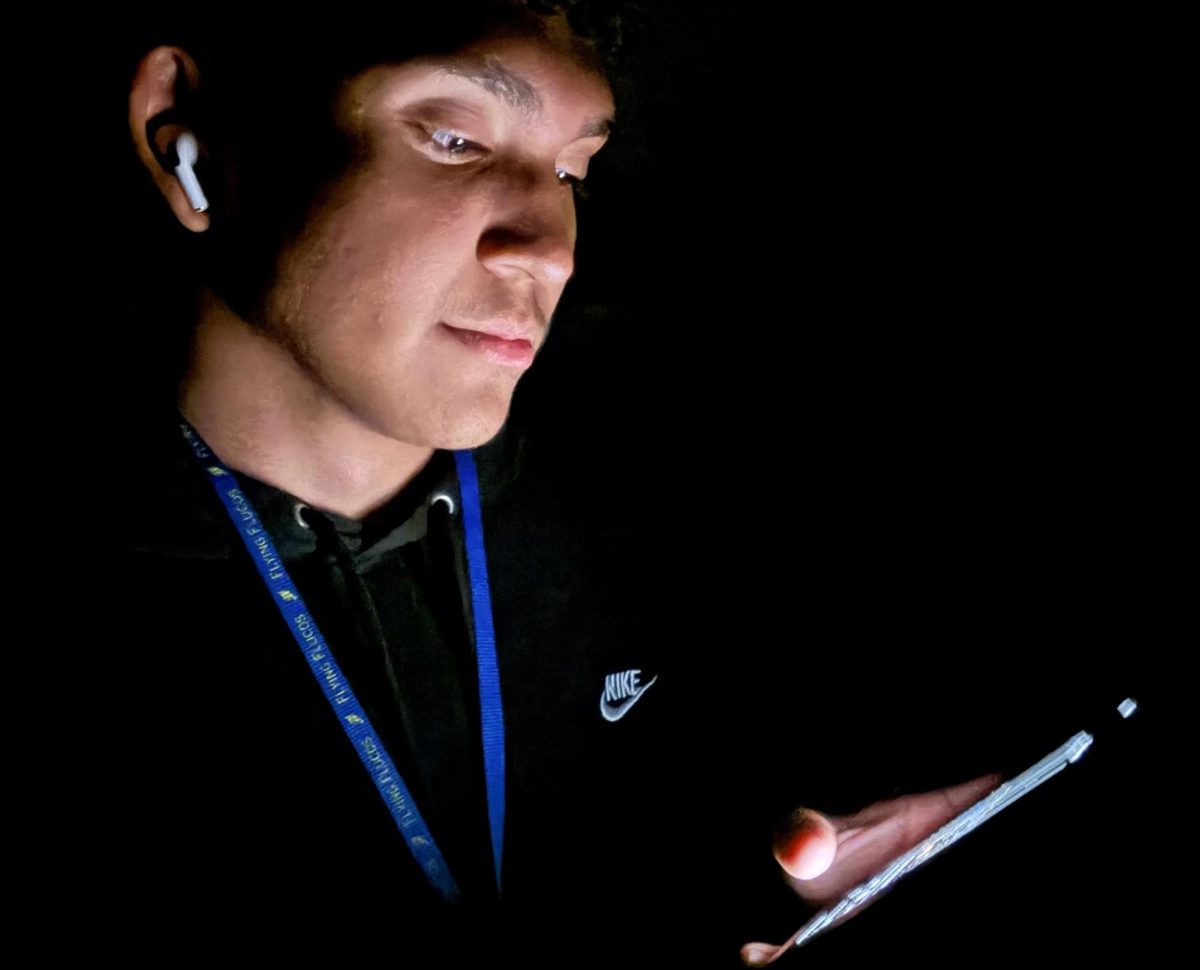
There’s a specific moment that happens in school hallways now. Something unexpected occurs—someone trips over a backpack strap, a teacher says something unintentionally funny, a friend reacts in a hilarious way that makes everyone lose it—and before the laughter even fades, phones rise into the air. The moment isn’t even over yet, but it’s already being archived.
Filming has become instinctive, almost automatic. It doesn’t even feel like a decision anymore. The second something feels funny, dramatic, impressive, or chaotic, we reach for proof.
And that word matters: proof.
We don’t just want to experience things—we want evidence that they happened. In some ways, that makes sense. We live in a fast-moving world where trends last a few hours and inside jokes expire by the next class period. Recording feels like a way to slow things down, or at least hold on to them for a little while longer. A video says, I was here. This was real. This mattered.
But something subtle shifts when we lift a phone between ourselves and a moment. Suddenly, we become aware of an audience. Even if we don’t think about it directly, we start framing the shot, checking the lighting, angling for the best reaction, and tapping the red button. The instant we start recording, the moment changes, the people in it change too. Laughter grows louder. Reactions sharpen. We perform—even if only by a fraction.
There is something called the observer effect: the idea that the act of observing something changes it. School feels like that sometimes. The second a phone appears, everything shifts a little. The second something might be posted, it becomes content instead of a moment. And content plays by different rules than real life. Content must be interesting. Content must be exaggerated. The content must be worth watching.
Real life, on the other hand, is usually quieter. It’s awkward sometimes. It’s unfinished. When we film, we trade subtlety for spectacle. That doesn’t mean recording things is bad. It’s not that simple. Capturing memories can actually be meaningful—sports games, graduation ceremonies, theater performances. Those recordings become time capsules, allowing us to revisit a version of ourselves we might otherwise forget.
But the scale has changed.
It’s no longer just milestone moments—it’s everything. Lunch jokes. Random class comments. Casual hallway interactions. Ordinary Tuesdays are treated like documentary footage. And here’s where it becomes interesting: the more we document, the more we curate. We don’t post awkward silence after the joke. We don’t post the nervous breath before the presentation. We don’t post the argument before the apology. We edit. We crop. We caption.
In doing so, we create a polished highlight reel of school life. But no one’s life actually feels like a highlight reel while they’re living it.
There’s also a memory paradox at play. Study suggests we rely on our devices to capture experiences, they often remember fewer details ourselves. The brain relaxes—the phone will remember, so we don’t have to. Instead of fully absorbing the sound, the emotion, the atmosphere, part of our attention shifts to framing it correctly.
We are present, but only partially.
At school, where people are still figuring out who they are, this matters. High school is already performative. We test personalities. We experiment with confidence. We adjust based on reactions. Add a camera, and that experimentation becomes permanent.
A joke that would have faded by third period now circulates beyond its original context. A minor mistake can loop endlessly. A single moment can define someone in ways they never intended. When everything is recorded, nothing feels small anymore.
And yet, the most powerful school memories are often the ones that never make it online—the quiet pep talk before a competition, the silent understanding between friends during stressful class, the laugh that happens when no one else is around. Those moments don’t need proof to be real. They don’t need views to be valid. They exist fully because they are experienced fully.
So maybe the conversation isn’t about stopping filming altogether. That’s unrealistic—and unnecessary. Documentation can be creative, connective, and even joyful. Maybe the real question is about balance. Before hitting the record button, what if we paused for half a second? What if we asked: Is this something I want to show or something I want to feel?
There is something quietly soothing about choosing presence over performance. About letting a moment belong only to the people in it. About trusting memory, even if it is imperfect. In a culture that rewards visibility, choosing not to record can feel like missing out, but in reality, it’s the opposite. Sometimes, the best moments are the ones no one recorded. No angle. No caption. No audience. Just the moment—unfiltered, unshared, and entirely yours.