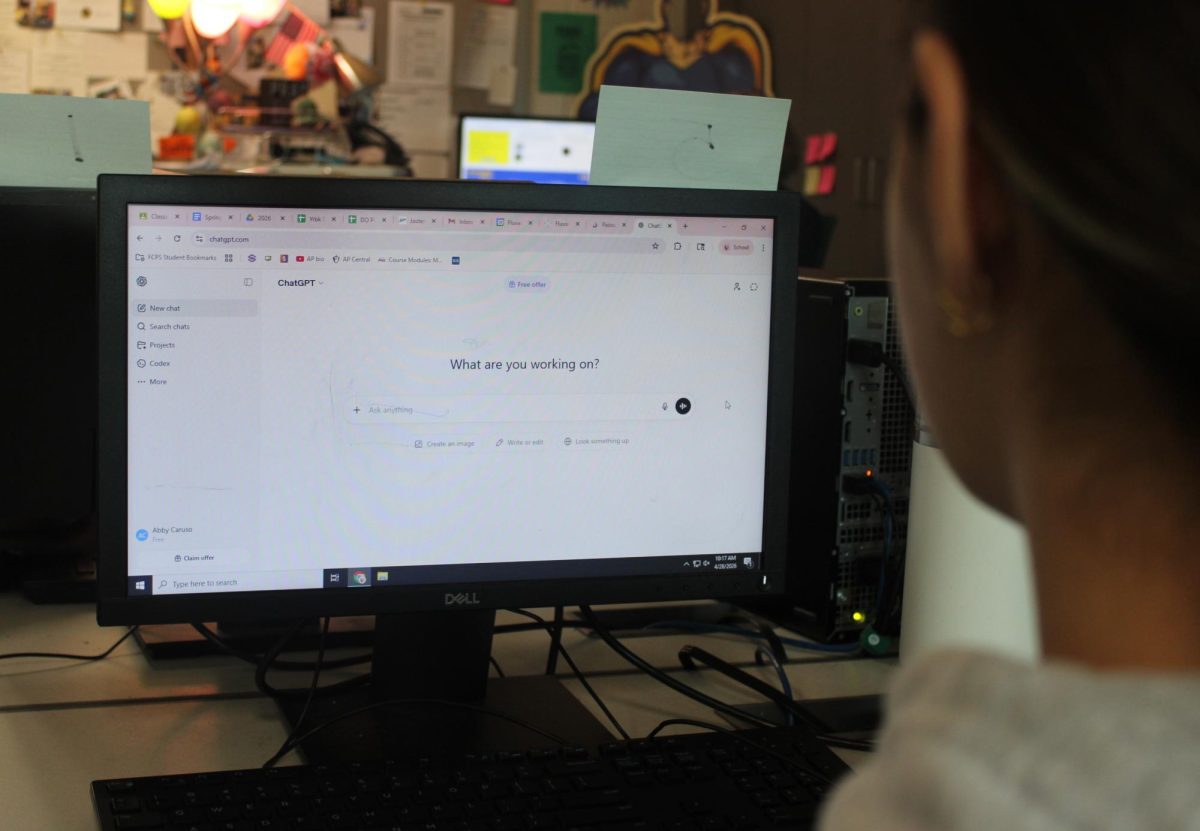
As reliance on A.I. has become more prevalent in today’s society, are we losing our ability to complete simple tasks that involve creative thinking? The evidence says yes.
One major concern is the use of A.I. in classrooms. According to the University of Maine School of Law, “the growing reliance on A.I. in academia raises significant concerns about creativity, critical thinking, academic performance, and ethical integrity.” In addition, The National Science Teaching Association (NSTA) notes that “Studies have indicated that when individuals rely heavily on AI for information retrieval and decision making, their ability to engage in reflective problem solving and independent analysis may decline.”
“I think AI is amazing and scary at the same time, and believe young students should not use it. For my high school classes, I always tell the kids not to let A.I. make them stupid. A.I. is great to check and polish your work, but you cannot rely on it to do your work. If students start to rely on A.I., they will lose all critical thinking skills and creativity,” said FCHS Computer Information Systems (CIS) teacher Christine Kreitzman.
“The use of AI has been exponentially increasing everywhere in the world, and especially in classrooms. The dependency of AI is actively ruining this generation’s critical thinking, creativity, and logic and reasoning. Why think so hard if a computer can do it for me? Because we are actively losing brain power by refusing to think for ourselves,” Said FCHS math teacher Danna Djinigou.
Creativity is also at risk due to the overuse of A.I. Simple tasks like writing and brainstorming are becoming harder and harder for the average A.I. user. If A.I. is used to create ideas, solve problems, and think critically, then humans will lose the ability to do those things. Over time, this could lead to a decrease in human productivity.
“The overuse of A.I. is a big problem because using A.I. is replacing creative independence in our society,” said FCHS sophomore Brooks Kaylor.
There are also ethical concerns when using A.I., especially when it comes to being honest and fair. Lots of students rely on A.I. to complete assignments, which raises questions about whether or not the work they submit is truly theirs.
“If students are taught how to use AI appropriately, I believe it can be a powerful resource that supports learning. At the same time, depending on how it’s used, it can create an unfair advantage, especially if it crosses into cheating,” said FCHS administrator Stacey Holland. Using A.I. to cheat on schoolwork can create unfairness in classrooms because some students may use A.I. and others may not. Over time, this could weaken education or create a larger gap between the educated and uneducated classes.
But not all students agree with this assessment. “I don’t think using A.I. is unfair. What’s unfair is students who do the work without A.I. and get blamed for using A.I., so in that sense, yes, it is unfair,” said junior Kaylee Lines.
A different concern with A.I. is that data centers that power our A.I. models have been popping up all over the United States. A large A.I. data center has the capability to consume up to 5 million gallons of water each day, according to the Environmental and Energy Studies Institute (EESI). The water is used to keep the systems cool and running smoothly. And while it is crucial to keep the systems cooled, the water it is using is borrowing from reservoirs used for farming, drinking, and many other things.
Along with the water usage issue, A.I. data centers require tons of electricity to stay operating. According to the Wall Street Journal, A.I. video generators can consume up to 1 kilowatt-hour of power for a single 10-second video. SORA A.I., a well-known A.I. video generator, is included in this, and so, due to the high energy consumption and high operating costs, SORA A.I.’s parent company announced it will shut SORA down at the end of April.
Another problem is how A.I. can impact decision-making in everyday life. As people become more and more dependent on A.I. every day, simple stuff like making decisions can become challenging and can also lead to trusting it too much to make decisions for you without wondering if it’s accurate or not. A.I. is not 100% accurate and can sometimes give inaccurate information.
There is some upside to using artificial intelligence. A.I. is a huge tool that can be used to automate human tasks that would take weeks or months, and make them happen in a day or less. This is important for our society because it could help us accelerate our advancements in technology and science. If we learn to use A.I. correctly, and to where it wouldn’t harm our intelligence, it could be a useful tool for humanity.
Still, the potential downsides to our dependency on A.I. are considerable.
“My biggest fear about A.I. is that students are trying to replace learning with A.I., but it just won’t work. Students will lose the ability to learn on their own,” Said FCHS science teacher Carolynne Hagen.